The flag of Lebanon
Western Asia · Beirut
- red50%
- white43%
- green7%
Sandwich. 13 flags share this layout, in different colours.
One plate per main colour.
Tap the flag to put it back together.
Investigation
Lebanon: a cedar set by the constitution
Lebanon’s flag has a green cedar between two red stripes, and its constitution says how big the cedar should be. Build it up a stripe at a time and check the artwork against the law. You’ll also see the flag it replaced in 1943.


Article 5 of Lebanon’s constitution describes the flag. It has three stripes running across it, a white one between two ones.
Article 5 gives no shape for the flag and no shades for its colours, and no law that does turned up. So the 2 by 3 shape and the colours here are the artwork’s own.
The stripe is as tall as the two red ones put together. So each red stripe takes a quarter of the flag’s height, and the white takes half.
In the middle of the white stands a green . Article 5 says its top touches the upper red stripe and its base touches the lower one. In this drawing it does, give or take a sliver too thin to see.
Article 5 sets the ’s size too. The Arabic text says it’s a third of the white stripe’s size. The French version on parliament’s website says the cedar’s width fills a third of the stripe. The English one says the cedar takes up a third of it. Read as width, that’s the middle of the flag.
This drawing’s cedar is a little narrower than that. It’s 246 units across where a third would be 250, and it sits a unit or two right of the middle. The French and English wordings are parliament’s own; the Arabic is our translation.
Article 5 hasn’t always said this. The constitution of 1926 gave Lebanon a flag of three upright stripes of the same width, , white and red, with a cedar on the white. A constitutional law of 7 December 1943 rewrote the article.
The 1926 article names the colours but gives no shades, no shape for the flag and no picture of the cedar, so those here are this drawing’s own.
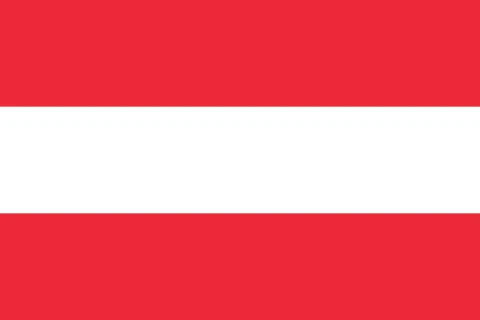
Adonis Nehme, a retired brigadier general who wrote a book on the flag and the national anthem, told the General Security magazine in 2019 how the new one came about. MPs couldn’t agree on a flag at independence, he said. Then Henri Pharaon, an MP, pointed to Austria’s red, white and red and suggested putting the cedar in the middle.
This is Nehme’s account. No law or government text that turned up says who designed the flag. The interview is in Arabic, and the words here are our translation.
Nehme says the flag was first raised on 21 November 1943, in the village of Bechamoun. Article 5 only caught up on 7 December, a little over two weeks later.
Nehme also told the magazine that when Lebanon’s president goes abroad on an official visit, no country flies the flag the way it should be, in his view. The cedar, he said, is often very small in the middle of a big flag.
Nehme gives no size for those cedars. The flag here is the real one, with its cedar close to a third of the white, as the law asks.
The presidency’s protocol rules say the flag flies every day from sunrise to sunset on state buildings, and at border posts, airports and ports. At the presidential palace the flags stay up day and night while the president is in Lebanon, and come down when the president travels abroad. Faded or torn flags mustn’t be flown.
The protocol rules are in Arabic, and the words here are our translation.
Flags that look like it
You’ll find Lebanon on these lists
Each one opens the list.
More flags taken apart in Asia
Each card opens that flag, taken apart step by step.