The flag of Uruguay
South America · Montevideo
- white59%
- navy36%
- brown2%
- yellow2%
Suns. Only 12 flags have one.
One plate per main colour.
Tap the flag to put it back together.
Investigation
Uruguay: nine stripes and a sun with a face
Uruguay’s flag has nine stripes and a gold sun with a face. Build it from its flag law of 1830 and a decree of 1952 that sizes the sun, count the sun’s rays, then go back to 1828, when the flag had nine blue stripes.


Uruguay’s flag law of 1830 is a single sentence. It asks for four blue stripes on a white field, spread out evenly. That makes nine stripes in all, five and four . A decree of 1952 adds that the first and the last stripes are white, and that the flag is half as long again as it is high.
In the top corner by the pole there’s a white for the sun. The 1952 decree says it reaches down to the sixth stripe, which is blue, and stops there. So it’s stripes deep, and this drawing makes it just as wide.
The decree’s word is cuadro, which can mean a square or just a box, and it only gives the depth. The width here is the artwork’s own.
On the square goes a gold . The decree makes it as wide as the square. The sun on this drawing comes out about 1% smaller than that.
The decree gives the sun sixteen rays, but it doesn’t say what they look like. The army’s rules for the flags its units carry do. Eight of them are , shaped like the tip of a spear. They’re lit up here, so you can count them.
The army’s rules describe the flags its units carry, not every flag. The decree itself only gives the number of rays.
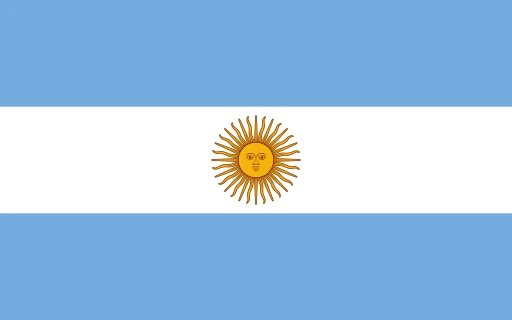
Between each two straight rays there’s a one, drawn to look like a flame. That’s eight more, so sixteen in all. The Sun of May on Argentina’s flag has twice as many.
In the middle of the sun there’s a . The decree just says the sun has one. The army’s rules make the round middle a third as wide as the whole sun, and so does this drawing. Canelones’s local government says the sun already had a face by tradition before the decree wrote it down.
The law that created Uruguay’s flag, on 16 December 1828, asked for a white flag with nine light blue stripes, and the sun on a white square by the pole. A second law, on 12 July 1830, cut them to four blue stripes and kept the rest. A decree of 1954 reads that as swapping the light blue for plain blue. Canelones’s local government and Britannica both say the nine stripes stood for the nine departments Uruguay had then. They say the nine stripes of 1830 kept that meaning.
The 1952 decree and Parliament’s library date the law that created the flag 16 December 1828, while Canelones’s local government gives 18 December. Britannica dates the second law 11 July 1830, a day earlier than the decree does.
The 1952 decree puts this flag first among Uruguay’s national symbols. It has the National Historical Museum keep a master copy of each one, and no copy may be made that doesn’t match its drawing, colours and proportions. Britannica links the sun to 25 May 1810 in Buenos Aires, the day Argentina’s Sun of May is named after.
Argentina’s Sun of May taken apart
You’ll find Uruguay on these lists
Each one opens the list.
More flags taken apart in the Americas
Each card opens that flag, taken apart step by step.