The flag of Central African Republic
Middle Africa · Bangui
- yellow22%
- green21%
- white21%
- navy20%
- red17%
Pan-African. It’s one of the flags in red, gold and green, the same colours as Ethiopia’s.
One plate per main colour.
Tap the flag to put it back together.
Investigation
The Central African Republic: a flag in one sentence
The Central African Republic’s constitution builds its flag in a single sentence. Four stripes of the same width get crossed in the middle by a red band that’s just as wide. Then a yellow star goes in the top left corner. Follow that sentence a piece at a time.


The flag comes from Article 1 of the constitution of 30 August 2023, and it takes just one sentence. The flag has five colours, it says, and four of them are horizontal stripes of equal width. So each stripe is of the height.
We read Article 1 in French, in a scan of the draft, headed Projet de la nouvelle Constitution, that the Central African Republic’s embassy in Paris publishes among its official texts. The Digithèque MJP, a law archive at the University of Perpignan, transcribes the text from the official gazette, and its Article 1 has the same words. The Ministry of Justice cites the constitution as dated 30 August 2023 and promulgated by decree No. 23.199 of the same day. We didn’t get to read the official gazette itself. The translations on this page are ours. The article gives the flag no shape, so its two high by three long here is the artwork’s.
Article 1 names the stripes’ colours in this order: blue, white, green and yellow. It doesn’t say which one goes on top. The artwork starts with blue at the top and works down in that order, and so does this page.
White is the second colour Article 1 names, and the artwork’s second stripe down. The constitution doesn’t give any of the colours a shade, so the shades on this page are the artwork’s.
Green comes third in the list, and third down in the artwork.
Yellow is the last colour named, and the artwork puts it at the bottom. That’s four stripes, all the same height.
Now the fifth colour. Article 1 says the stripes are crossed at right angles, at their middle, by a red band of equal width. It doesn’t say equal to what. The only width it’s given is the stripes’, so we take it to mean that. The red band runs down the middle of the flag, and it’s as wide as each stripe is high. Both are of the flag’s height.
The sentence ends with a yellow star with five points, in the upper left corner. The embassy in Paris says the star guides the steps of the Black people towards freedom and emancipation.
The constitution doesn’t say how big the star is or exactly where it sits in that corner. Its size and place on this page are the artwork’s.
Here’s the whole flag. The Central African Republic’s embassy in Paris says President Barthélemy Boganda presented it to the Legislative Assembly on 1 December 1958. The embassy says that’s also the day Ubangi-Shari became the Central African Republic.
The constitution doesn’t say what the colours stand for. The embassy’s page gives two readings, and they differ. In the one it calls the most widespread, the blue, white and red come from the flag of France, the former colonial power, and the green, yellow and red are the pan-African colours. In the other, blue is the Congo and its ocean, white is Chad and its cotton, green is Gabon and its forests, yellow is the Central African Republic and its mineral wealth, and red is the blood shed by all the martyrs.
You’ll find Central African Republic on these lists
Each one opens the list.
More flags taken apart in Africa
Each card opens that flag, taken apart step by step.
- ChadChad: three colours, no numbers
- ComorosComoros: a flag you can draw from its constitution
- Côte d'IvoireCôte d’Ivoire: three more words for the bands
- Democratic Republic of the CongoThe Democratic Republic of the Congo: a sentence from 1964
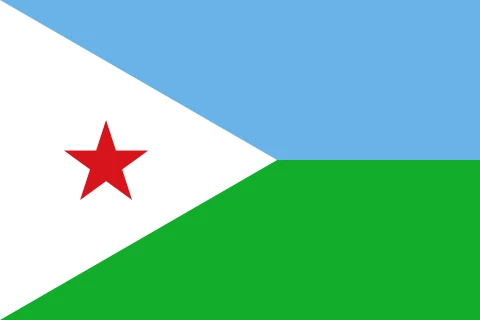
- DjiboutiDjibouti: a flag in a list of colours
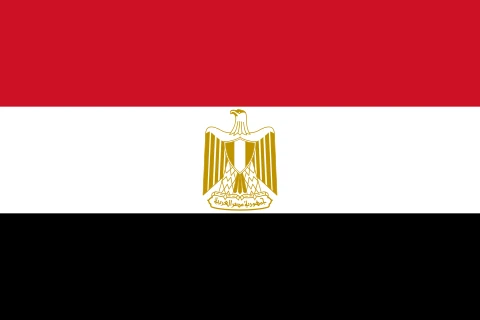
- EgyptEgypt: the Eagle of Saladin