The flag of New Zealand
Australia and New Zealand · Wellington
- navy80%
- red10%
- white9%
Red, blue and white. 26 other flags use just these colours.
One plate per main colour.
Tap the flag to put it back together.
Investigation
New Zealand: four stars on royal blue
New Zealand’s law, the Flags, Emblems, and Names Protection Act 1981, makes the old New Zealand Ensign the country’s flag, and it shows the flag only as a picture. The words that place its stars are older. They’re in a notice in the New Zealand Gazette of 27 June 1902, which measures everything in sixtieths of the hoist. The hoist is the flag’s height, along the side by the pole. Build the flag a piece at a time from that notice.


The 1981 Act says the flag “hitherto known as the New Zealand Ensign” is the New Zealand Flag, and its Schedule 1 is just a picture. Manatū Taonga, the Ministry for Culture and Heritage, says the flag has a background. It says the flag can be any size, as long as it’s always twice as long as it is high. So it’s long for every high.
The Act we read is the official reprint of the Flags, Emblems, and Names Protection Act 1981, as at 23 April 2014. Manatū Taonga gives the official colours as Pantone 280C for the blue, Pantone 186C for the red, and white. The shades on this page are the artwork’s, which are close to the ministry’s own digital ones but not quite the same.
The ministry says the goes in the first quarter, the top corner by the pole. It’s the United Kingdom’s own flag, and that flag’s page takes it apart cross by cross.
The Union Jack taken apartNow the stars, and the 1902 notice places every one. The two on the long arm of the cross sit on an upright line halfway between the Union Jack and the end of the flag, as far from the top as from the bottom. Their centres are of the hoist apart. Te Ara, the ministry’s encyclopedia, says the star at the top of the real cross is , and the brightest one, at its foot, is .
The 1902 notice names the stars only by where they sit on the flag. The two names here come from Te Ara’s page on the Southern Cross, which is about the stars in the sky. It also says the faint fifth star, Epsilon Crucis, isn’t on New Zealand’s flag.
The notice measures each star across its red points. The top star is of the hoist across, and the bottom one is , the biggest of the four.
The notice doesn’t say any more about how to measure “across their respective red points”. The artwork draws each star that wide from tip to tip, and so does this page.
The other two stars sit on a second line, the short arm of the cross. It crosses the upright line of the hoist below the centre of the top star, at an angle of . It rises from near the Union Jack towards the top corner at the end of the flag.
Manatū Taonga’s copy of the notice prints the angle as just “82”, with no sign after it. We read it as degrees, and that’s how the artwork draws it.
The star nearest the end of the flag sits of the hoist out along the short arm from where the lines cross. It’s the smallest of the four, across.
The star nearest the Union Jack sits a little further out on the other side, of the hoist from where the lines cross. It’s across, the same as the top star.
Every star has a . The notice makes each one a hundred-and-twentieth of the hoist wide, which is half a sixtieth by our own sum. That’s the last thing it says about the stars.
Here’s the whole flag. Manatū Taonga says it was designed in 1869 by Admiral Sir Albert Hastings Markham, and NZHistory says it was adopted that year as the blue ensign for government ships. In 1902 it was proclaimed the colony’s flag for general use on shore as well, and the notice that June made its stars a good deal larger than before. The 1981 Act calls it “the symbol of the Realm, Government, and people of New Zealand”. In a referendum in 2016, the Electoral Commission counted 56.6% of the votes for keeping this flag and 43.2% for a Silver Fern flag, so it stayed.
Manatū Taonga says the blue is reminiscent of the sea and sky around New Zealand, and that the stars of the Southern Cross signify the country’s place in the South Pacific Ocean. Neither the 1981 Act nor the 1902 notice gives the colours a meaning.
Taken apart beside other flags
It’s also on these pages, compared with flags like it.
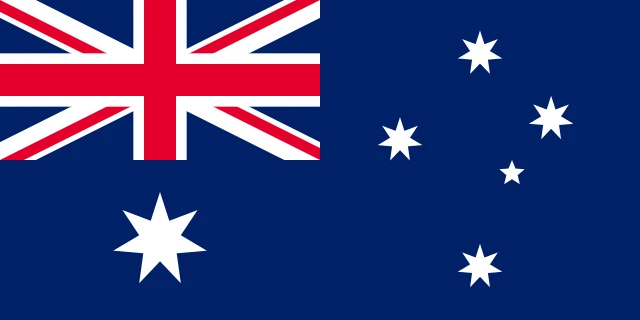
Flags that look like it
You’ll find New Zealand on these lists
Each one opens the list.
More flags taken apart in Oceania
Each card opens that flag, taken apart step by step.
- PalauPalau: a full moon just off the middle
- Papua New GuineaPapua New Guinea: a bird of paradise on a circle
- SamoaSamoa: five stars on a blue quarter
- Solomon IslandsSolomon Islands: five stars that stayed five
- TongaTonga: a flag never to be altered
- TuvaluTuvalu: is it a map of the islands?