The flag of Rwanda
Eastern Africa · Kigali
- blue48%
- yellow26%
- green25%
Suns. Only 12 flags have one.
One plate per main colour.
Tap the flag to put it back together.
Investigation
Rwanda: a sun placed by letters
Rwanda’s flag law ends with a drawing that sets the flag out in letters, from its stripes to its sun. Build the flag from them, count the sun’s rays, and find the one letter this drawing doesn’t follow.


Rwanda’s flag law of 2008 ends with an annex, a drawing that sets the flag out in letters, and it says every flag is made the way that annex shows. It calls the height and the length , and it makes Y one and a half times X.
Until 2013 the law gave sizes in centimetres too, like 195 by 130 for the flag in front of public buildings. A law that year rewrote the article and left each flag’s size to an order from a minister. No such order turned up, so this page goes by the annex.
From the bottom up, the constitution and the flag law say the same thing. There’s a green stripe, then a yellow one, and the two of them cover half the flag. The top half is blue. In the annex, the blue is half of X, and the yellow and the green are a quarter each.
On the right-hand side of the blue, the law puts a with its rays, in golden yellow. A blue keeps the sun and its rays apart.
Neither the law nor the constitution says how many rays there are. The annex’s drawing has , one every 15 degrees, and so does this one. Count them round this circle.
Tip to tip, the rays are across. The annex writes D = , an eighth of the length, and rays that long would only reach this dashed circle. This drawing takes them further, to about 0.215 of Y. That’s what the law gave until 2013, 42 centimetres on a flag 195 long.
The annex’s own picture isn’t drawn to its letters, so it can’t settle this. Measured on it, the rays come to about a quarter of Y. Before 2013 the law sized the sun on two other flags too, and both came to about the same share as 42 on 195.
Two gaps place the sun. Above the rays, the annex leaves , a tenth of X, and the sun in its ring is across, just as wide. Beside the rays it leaves , a third of D. This drawing keeps all three, with D the way it draws it.
Article 6 gives every colour a code. The blue is Pantone 299 C and the green is RAL 6029. The yellow stripe is RAL 1023, but the sun gets a golden yellow of its own, RAL 1003. So the sun isn’t the stripe’s yellow, and this drawing paints them in two different yellows too.
The law writes the blue as “Pantene 299 C 2x”, spelled a little differently in each of its three languages, and it doesn’t say what the “2x” means. This page reads it as Pantone 299 C.
Article 5 gives the meanings. Blue is for happiness and peace, and yellow is for economic development. Green is the hope of prosperity, from Rwandans putting their strength and their country’s resources to good use. The golden sun and its rays are the light that spreads to everyone little by little, and the law says they stand for unity, transparency and the fight against ignorance.
The 2008 law says it reviews an earlier flag law, one of 31 December 2001. Britannica says this flag was first hoisted that day, in place of a red, yellow and green flag with a black R. The law also puts the pole on the side parallel to the one with the sun, so the sun flies at the far end.
You’ll find Rwanda on these lists
Each one opens the list.
More flags taken apart in Africa
Each card opens that flag, taken apart step by step.
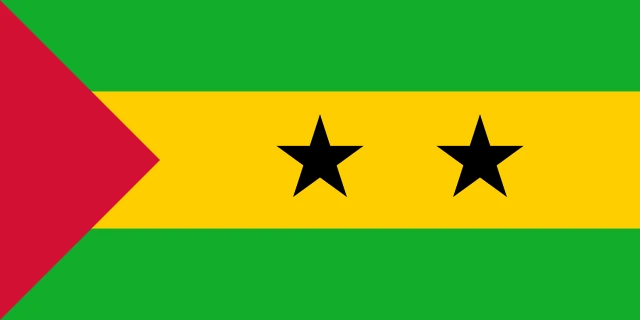
- São Tomé and PríncipeSão Tomé and Príncipe: one and a half, and a half
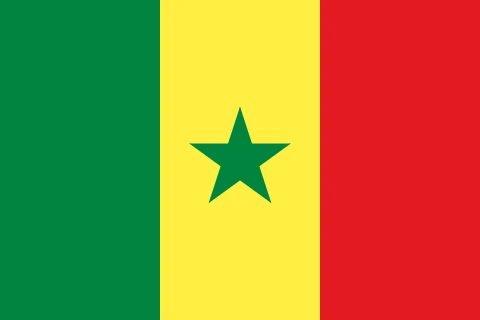
- SenegalSenegal: the star that took the kanaga’s place
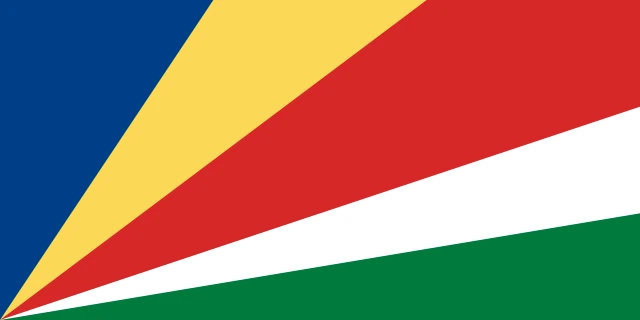
- SeychellesSeychelles: five bands from one corner
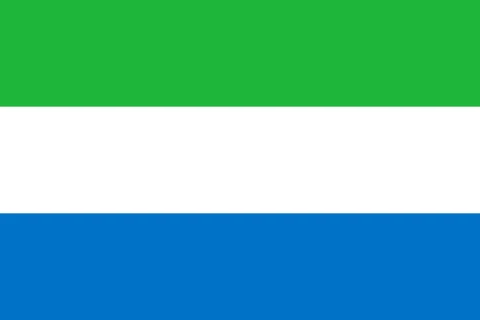
- Sierra LeoneSierra Leone: nine units across, six down
- SomaliaSomalia: a star with five equal points
- South AfricaSouth Africa: the story of the Y