The flag of Saint Lucia
Caribbean · Castries
- light blue86%
- yellow7%
- black4%
- white3%
Colours all its own. No other flag is painted in just gold, blue, black and white.
One plate per main colour.
Tap the flag to put it back together.
Investigation
Saint Lucia: three numbers and the Pitons
No flag law turned up for Saint Lucia. What sets out its flag is its designer’s own description, and the government publishes it on its website. It gives just three numbers for the triangles, and together they’re enough to work out how tall the white one is. Here’s how they fit together, and what the government says the colours stand for.
Saint Lucia’s flag was designed by the artist Dunstan St. Omer, and the government’s website quotes his own description of it. It starts with a plain blue field. The government gives two sizes, 6 feet by 3 and 9 inches by 4½, and both are twice as long as they’re high. In inches, the big one is long and high. The government calls the blue cerulean, and it says cerulean blue represents fidelity.
No flag law turned up. We went through the index of the Revised Laws of Saint Lucia, and the Constitution doesn’t describe the flag. So this page follows the description on the government’s website. It doesn’t say which size its inches are for, but we take it to be the 6 foot flag, because on a 9 inch flag 4 inches between the peaks would be nearly its whole height. Every figure on the picture is in inches.
Next come the triangles. The government says they share a common base, and that its length is one third of the flag’s. A third of 72 inches is .
We’ve read “a common base” as the triangles standing on the same line, as the artwork we draw from has them. That leaves the black triangle’s foot a little shorter than the others’.
The white triangle goes on first. The government says it’s an isosceles triangle, so its two sloping sides are the same length. It says the shape is reminiscent of the island’s famous twin Pitons at Soufrière, “rising sheer out of the sea, towards the sky”. Nothing in the description says how tall the triangle is. But the next two numbers are enough to work it out.
The black triangle goes on the white one. The government says the white part is inches wide on both sides of the black. We take that to mean the black’s sides run alongside the white ones, the same distance in all the way up.
The second number is the gap at the top. The government says the distance between the peaks of the black and white triangles is inches.
Here’s where the two numbers fit together. The 4 inches from peak to peak and the 1½ inches of white across the side make a little right-angled triangle. It’s the same shape as half of the white triangle. In the little one, 4 is two and two thirds times 1½. So the white triangle’s side is two and two thirds times half the base, which is 12 inches, and that comes to . That makes the white triangle a little under 30 inches tall. These sums are ours, not the government’s, and the artwork we draw from matches them.
Our sums take the 1½ inches straight across the white, square to its side. The government’s text doesn’t say which way it’s measured.
Last comes the gold triangle, on the same base, laid over the black. The government says gold represents the prevailing sunshine in the Caribbean, and prosperity. It doesn’t say how tall the gold triangle is.
Here the gold triangle’s peak is at the centre of the flag, because that’s where the artwork we draw from puts it. The government’s text doesn’t give its height, and it doesn’t say where the triangles sit between the top and bottom of the flag either, beyond saying the black ends as a three-pointed star “in the centre of the flag”. The artwork puts the white triangle halfway, and so do we. The picture on the government’s own page is drawn a little differently, and not to its numbers.
The government says black and white stand for the cultural influences. The white part is the white culture and the black part is the black culture, “the two races living and working in unity”. It says the blue reflects the tropical sky and the waters round the island, the Caribbean Sea and the Atlantic Ocean. The same page also says the three triangles symbolise three pitons, just before it likens the shape to the twin Pitons.
Britannica says the first version of Dunstan St. Omer’s flag was hoisted in 1967, when Saint Lucia became an associated state. It says the shade of blue and the relative sizes of the gold and black triangles were slightly altered at independence in 1979. The government’s code of etiquette says the flag should never be flown with the peaks inverted, except as a signal of distress. And under the Customs (Control and Management) Act, goods that bear the flag can only be brought in with the minister’s approval.
More flags taken apart in the Americas
Each card opens that flag, taken apart step by step.
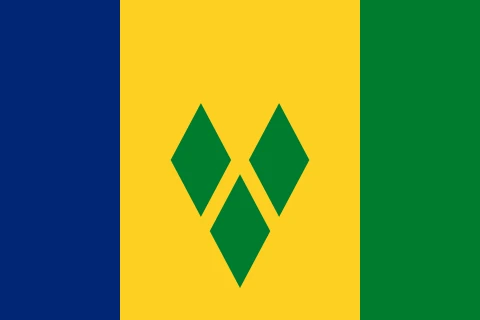
- Saint Vincent and the GrenadinesSaint Vincent and the Grenadines: three diamonds in a V
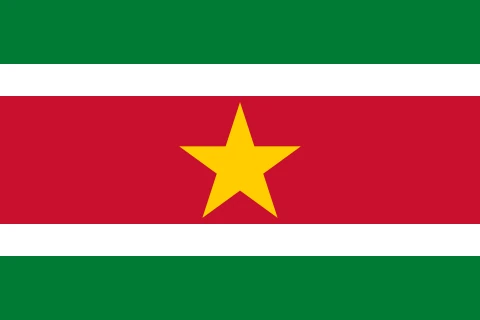
- SurinameSuriname: the circle that sits low
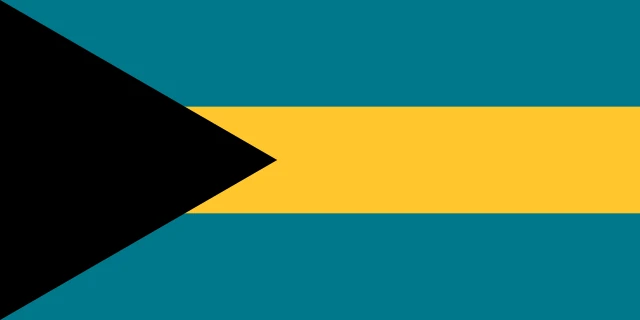
- The BahamasThe Bahamas: eleven words of heraldry
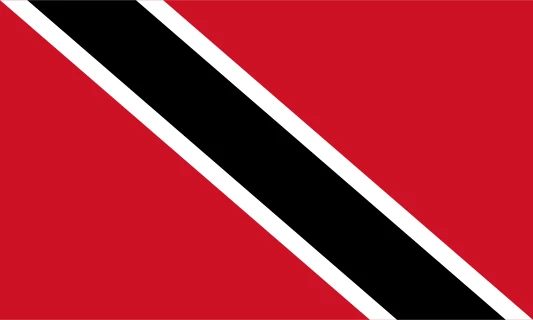
- Trinidad and TobagoTrinidad and Tobago: not quite a diagonal
- United StatesThe United States: fifty stars by order
- UruguayUruguay: nine stripes and a sun with a face