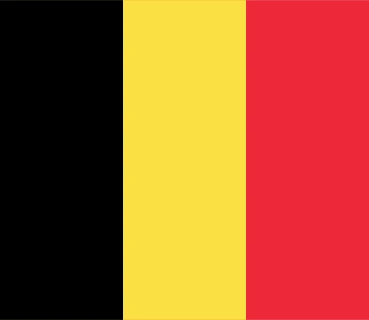
The flag of Germany
Western Europe · Berlin
- black33%
- red33%
- yellow33%
Three stripes. 35 flags share this layout, in different colours.
One plate per main colour.
Tap the flag to put it back together.
Investigation
Germany: black, red and gold-coloured
Germany’s Basic Law gives its flag one line, and an order from 1996 fills in its stripes and its shape. Neither of them gives the colours a code. Build the flag from that order a stripe at a time, then see where black, red and gold came from, and the years they were set aside.
Germany’s constitution, the Basic Law, gives the flag one line. Article 22 says the federal flag is black, red and gold, and that’s all it says. The rest is in an order the Federal President made in 1996, at the government’s suggestion, which is still in force. It says the flag has three stripes of the same width running across it, with at the top.
The goes in the middle. Since the stripes are all the same width, each one takes up a third of the flag’s height.
The goes at the bottom. The Basic Law says gold, but the order’s word is goldfarben, which means gold-coloured.
The order gives the flag its shape as well. Its height is to its length as is to , so a flag 3 metres high is 5 metres long.
Neither the Basic Law nor the order gives the colours a code. The interior ministry’s protocol office says flags should come as close to the order’s words as they can. It says that, depending on what a flag’s made of and the light it’s seen in, codes from different colour standards can match. The sun and the weather make the same flag look different anyway. The government’s styleguide does give its own logo exact colours for screens, though: for black, for red and for gold.
Those codes are for the government’s logo, not for flags. The stripes here keep the artwork’s own colours, a red of #DD0000 and a gold of #FFCE00.
Nobody can prove where black, red and gold come from, the Bundestag says. After the wars against Napoleon ended in 1815, people traced them to the Lützow Free Corps, who fought him in uniforms with trim and buttons the colour of . A students’ fraternity founded in Jena in 1818 took up the colours, thinking they were the old empire’s. At the Hambach Festival in 1832, where the interior ministry says about 40 000 people gathered, many of them carried black, red and gold flags.
The interior ministry says it’s disputed how much the Lützow uniforms had to do with it. It describes them as black with red trim and doesn’t mention the buttons.
On 9 March 1848, during a revolution, the German Confederation’s assembly declared black, red and gold its colours. When the revolution failed, the flag disappeared for a while as a symbol of the whole country. Later, as chancellor of the North German Confederation, which lasted from 1867 to 1871, Bismarck gave its navy and its merchant ships a new flag in black, white and red. The Bundestag says black and white were Prussia’s old colours, and red stood for the Hanseatic towns. The German Empire made it the national flag in 1892.
After 1919 the colours split the Weimar National Assembly and the country. The assembly settled on a compromise, which the Bundestag quotes: the Reich colours are black, red and gold, and the merchant flag is black, white and red with the Reich colours in the upper inner corner. The interior ministry says the quarrel went on, and in 1926 it even brought down the government. In 1935 the Nazi party forced its own flag on the nation, and a law made it the national flag.
In 1949 the Parliamentary Council, which wrote the Basic Law, chose black, red and gold for the Federal Republic’s flag, with one vote against. One speaker there, the interior ministry says, called its tradition unity in freedom. East Germany chose the same colours, and from 1959 it put its emblem on the flag. At midnight on 3 October 1990, when the Basic Law took effect in the east too, the black, red and gold flag went up outside the Reichstag building.
Flags that look like it
You’ll find Germany on these lists
Each one opens the list.
More flags taken apart in Europe
Each card opens that flag, taken apart step by step.