The flag of Namibia
Southern Africa · Windhoek
- green32%
- navy29%
- red28%
- white8%
- yellow3%
Suns. Only 12 flags have one.
One plate per main colour.
Tap the flag to put it back together.
Investigation
Namibia: a flag built from its constitution
Namibia’s constitution doesn’t just name the flag’s colours. Its Schedule 6 sets out how to build the whole thing, right down to where the sun goes and how long its rays are. Build it step by step, then read what the government has said it stands for and see where its shades are written down.


Article 2 of Namibia’s constitution says the country shall have a national flag, and Schedule 6 describes it. The flag is a rectangle in the length to in the width, so the schedule’s width is the short side. It’s split in three on the slant, blue, white and green. Start with the line they’re laid along. It runs up from the bottom by the pole to the top of the far end, with the blue above it and the green below.
Schedule 6 is quoted from the Government Gazette of 21 March 1990, which published the constitution. None of the three acts that have amended the constitution since then changes it. In heraldry, its “per bend reversed” is a slant running up from the bottom by the pole. The schedule doesn’t say the line runs exactly corner to corner, but this artwork draws it that way, and so do we.
Along that line goes a white band, which the schedule calls the white bend reversed. It’s of the width of the flag.
The schedule doesn’t say which way to measure the bands. We’ve measured them straight across, at right angles to the slant, as this artwork does.
The white band “is charged with another of red”, the schedule says, and the red is of the width of the flag. In heraldry, that puts it down the middle of the white, so a thin white edge shows on each side. By our sums, each edge is a 24th of the width.
Now the sun. The schedule puts it in the upper hoist, the corner by the top of the pole, with its vertical axis of the distance from the hoist. So its centre sits somewhere on this upright line, a fifth of the way along the flag.
The schedule doesn’t give the sun’s height as a number. It puts the sun “equidistant from the top edge and from the reversed bend”. So slide down the line until the gap up to the top edge matches the gap across to the white band. That’s the centre. By our sums, it’s about 27.2% of the way down the flag.
We’ve read “the reversed bend” as the edge of the white band, which is where this artwork puts the sun. Measured to the red, or to the middle of the band, the sun would sit lower.
The sun itself is gold, with twelve straight rays. The schedule makes its diameter of the width of the flag, the same share as the white band.
We’ve read the sun’s diameter as running from the tip of one ray to the tip of the opposite one, as this artwork draws it.
Up close, each ray is of the sun’s radius long. The rays come out of the outer edge of a blue ring, which is of the radius. Inside the ring, this artwork’s sun is plain gold, and by our sums that gold takes up half the radius.
The schedule doesn’t say how wide the rays are or which way they point. This artwork makes them pointed, with one straight up. The 2018 act calls the rays “triangular” where it describes the sun on the coat of arms, but for the flag the constitution only says “straight”.
In 2015 the government’s website said the Constituent Assembly adopted the flag unanimously on 2 February 1990, as a symbol of the country’s struggle for national unity. The sun symbolises life and energy, it said, and its gold represents warmth and the colour of the plains of the Namib Desert. The blue symbolises the sky, the Atlantic Ocean, Namibia’s marine resources and the importance of rain and water. Red represents the Namibian people, their heroism and their determination to build a future of equal opportunity for all. White refers to peace and unity, and the green symbolises the country’s vegetation and agricultural resources.
We read the government’s page in a copy saved in 2015, as the site doesn’t load for us today. The constitution itself was adopted by the Constituent Assembly on 9 February 1990, a week after the flag, and published on 21 March.
Schedule 6 names the colours but gives no shades. The only ones we found are in the National Symbols of the Republic of Namibia Act of 2018, in its rules for the Presidential Standard, the President’s flag. Its colours must be the same as the national flag’s, the act says, and it lists them as Pantone 294C for the blue, 116C for the yellow, or gold, 347C for the green and 186C for the red. There’s no white on the list. The same act says the national flag must be raised at sunrise and lowered at sunset.
Beside each Pantone number the act gives a Coates SP one. The shades in this artwork are its own, not the act’s.
You’ll find Namibia on these lists
Each one opens the list.
More flags taken apart in Africa
Each card opens that flag, taken apart step by step.
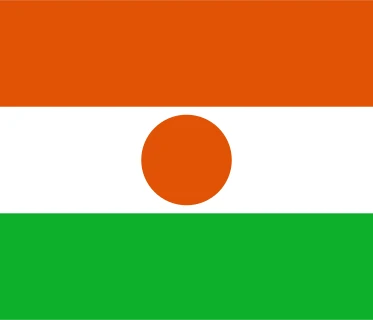
- NigerNiger: three bands and a disc
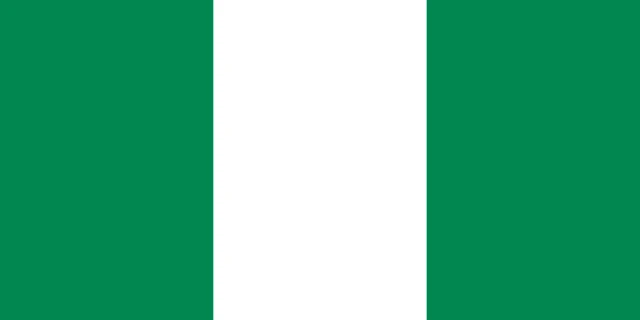
- NigeriaNigeria: two squares and a white stripe
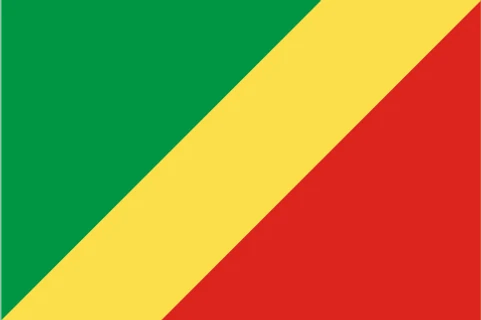
- Republic of the CongoThe Republic of the Congo: a third each
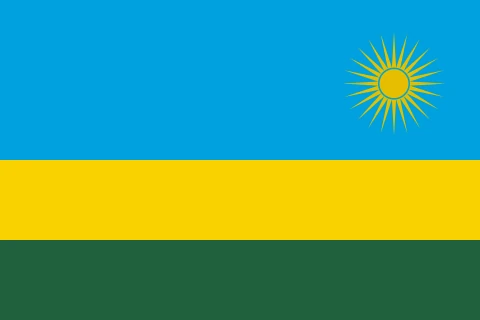
- RwandaRwanda: a sun placed by letters
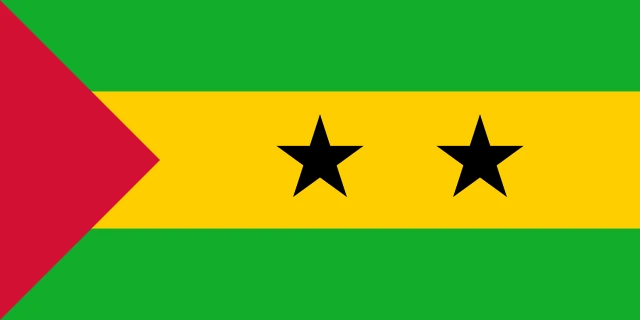
- São Tomé and PríncipeSão Tomé and Príncipe: one and a half, and a half
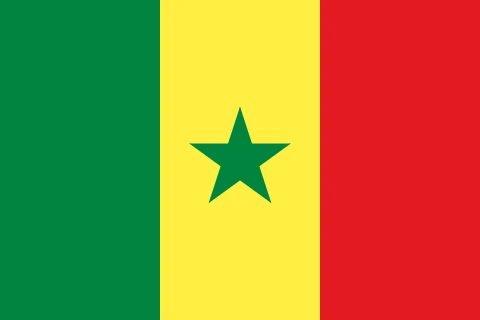
- SenegalSenegal: the star that took the kanaga’s place