The flag of Poland
Central Europe · Warsaw
- white50%
- red50%
Two stripes. 11 flags share this layout, in different colours.
One plate per main colour.
Tap the flag to put it back together.
Investigation
Poland: why the white is on top
Poland’s flag is two stripes of the same width, white over red. Build it from the 1980 law, and hear why two ministries say the white goes on top.
Poland’s flag is set out in a law of 1980 on the country’s emblem, colours and anthem, which has been changed a number of times since. One of its drawings carries a line saying the flag’s width is to its length as 5 to 8, and the width there is the side by the mast. So the flag is high and long. Poland’s law of 1919 drew the flag at 5 to 8 too.
We quote the 1980 law as it stands in its latest consolidated text, published in 2025, which takes in its changes so far. The translations from Polish on this page are our own.
The law says Poland’s colours are white and red, set in two horizontal stripes of the same width. The upper one is and the lower one is .
Poland’s Foreign Ministry says the colours come from two coats of arms, the Kingdom of Poland’s and the Grand Duchy of Lithuania’s. The white is the white of the eagle, Poland’s emblem, and of the Pogoń, the knight galloping on horseback that’s Lithuania’s emblem. Both stand on red shields. The ministry says the white went on top because in Polish heraldry the is more important than the . The Culture Ministry gives the same reason.
The Foreign Ministry says white and red were formally adopted as the Polish state’s colours in 1831, during the November Uprising, by the Sejm of the Kingdom of Poland. The Culture Ministry says that Sejm passed an act on the colours of the flag on 7 February 1831. The Institute of National Remembrance, a state body, reads it differently. It quotes the resolution, which says the national cockade will be the colours of the arms of the Kingdom of Poland and the Grand Duchy of Lithuania, that is, white with red. And it says the resolution was about the military cockade, which showed which state a soldier belonged to, and not about the flag.
We haven’t found the 1831 resolution itself, so its words here are the institute’s quote. We haven’t drawn a cockade either. The institute says a 2014 order of the defence minister puts the white in the middle, ringed by red, while heraldists and pictures from the partition era have it the other way round.
The law doesn’t give the red any name but red. It sets both colours by numbers instead. Each gets a point on the CIE colour chart and a brightness, and the law says how far a flag may stray from them. The white is at and the red is at . Older rules used a word. A decree of 1927 said the red matched the colour of vermilion, and a decree of 1955 said so too. The Institute of National Remembrance says the red was crimson at first and turned to vermilion in 1927, and that today’s shade is a little darker than vermilion.
On this step the flag is painted in our own conversion of the law’s figures to screen colours, #EDE9E5 and #D7213E. The law measures under standard light C, and we’ve adapted that to a screen’s daylight. It gives its white a brightness of 82 where a screen’s white is 100, so ours comes out slightly grey. The other steps use the artwork’s #FFFFFF and #DC143C. By our sums the artwork’s red is 7.7 from the law’s on the law’s own scale, just inside the 8 it allows.
When the colours are hung vertically, the law puts the on the left as you look at them from the front, so the is on the right. A guide to using the state symbols, published on gov.pl, says a flag hung upside down no longer symbolises the Polish state.
The law gives this rule for the colours hung vertically, not a shape, so we’ve drawn the flag turned on its side and smaller than on the other steps.
The law has a second state flag too. It’s the same white and red, with the emblem in the middle of the white stripe. The emblem is a white eagle on a red shield, with a golden crown on its head and a golden beak and talons, and the law’s drawing makes its height to the flag’s height 2 to 5. The law says who hoists it. Diplomatic missions, consulates and other official missions abroad do, and so do their heads on their residences and cars, where international law and custom call for it. So do civil airports and airfields and harbour masters’ offices. Civil airliners hoist it on flights abroad, and Polish sea-going ships fly it as their ensign. The gov.pl guide says ordinary citizens shouldn’t use it, because it’s kept for the bodies the law names.
We haven’t drawn it. The eagle is a detailed drawing in the law, and the artwork we build these pages from shows only the plain flag.
Poland’s constitution says simply that the colours of the Republic are white and red. Since 2004 the law has made 2 May Poland’s Flag Day. The Education Ministry says the date recalls, among other things, 2 May 1945, when the Polish flag was hung in Berlin on the Reichstag and on the Victory Column.
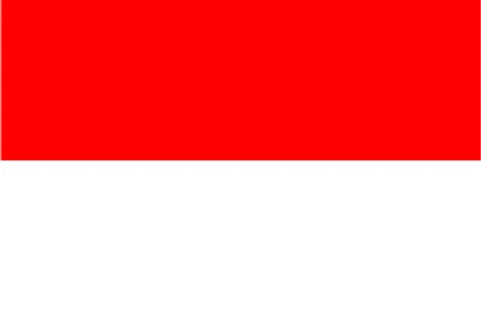
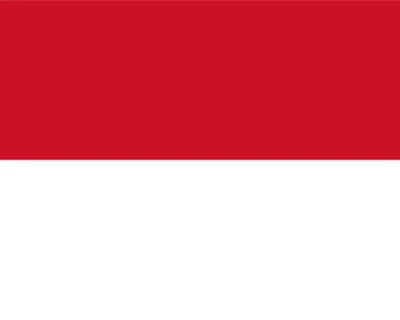
Flags that look like it
You’ll find Poland on these lists
Each one opens the list.
More flags taken apart in Europe
Each card opens that flag, taken apart step by step.