The flag of Cameroon
Middle Africa · Yaoundé
- yellow35%
- green33%
- red32%
Pan-African. It’s one of the flags in red, gold and green, the same colours as Ethiopia’s.
One plate per main colour.
Tap the flag to put it back together.
Investigation
Cameroon: two stars that became one
Cameroon’s constitution describes its flag in a couple of lines: three equal vertical bands of green, red and yellow, and a gold star at the centre of the red. Britannica says the flag had no star at all in 1957, and two on the green from 1961, until one star took their place in 1975. Here’s the flag built from the constitution, and the story of its stars as Britannica tells it.


Article 1 of Cameroon’s constitution describes the flag in two sentences in its French text, and in one in its English. Neither text says how long the flag is for its height. So this , 3 by 2, is the shape of the artwork we draw from, not the constitution’s.
The first sentence says the flag has three vertical bands of equal size. So the field splits into three, and each band takes a of its length.
Britannica gives the flag’s proportions as about 2 to 3, height to length. That’s the same shape as the artwork’s 3 by 2, but it’s Britannica’s figure, not the constitution’s.
The same sentence names the colours as green, red, yellow. It doesn’t say that’s their order across the flag, or which side the green goes on. The artwork puts by the pole and in the middle, with at the far end, and we follow it.
Britannica says that while most of Cameroon was a trust territory run by France, its legislature chose a simple flag of three equal vertical stripes, inspired by the French tricolour, in green, red and yellow. It says the flag was first officially hoisted on 29 October 1957, and kept when Cameroon became independent on 1 January 1960. It had no star on it.
Britannica says that on 1 October 1961, when part of the British Cameroons joined the country, two yellow stars were added to the band. It doesn’t say where on the green they sat, or how big they were, and we didn’t find an official text that does. So we haven’t drawn them, and this picture isn’t the 1961 flag.
Britannica says today’s design dates from 20 May 1975, when a single star took the place of the two, as a symbol of national unity. The French text says it in its second sentence on the flag: it bears a gold at the centre of the red band.
The constitution doesn’t give the star a size, or say how many points it has or which way it points. Its five points, its size and its one point straight up are the artwork’s. The constitution calls the star gold, Britannica calls it yellow, and the artwork paints it the same yellow as the last band.
The flag is set out in article 1 of the constitution, as it was revised by Law No. 96/06 of 18 January 1996. The two revisions since, in 2008 and in April 2026, changed other articles and left article 1 alone.
We quote article 1 from the certified copy of Law No. 96/06 that the President’s office publishes in French, and the translations are ours. Its certified English copy says the same in one sentence: three equal vertical stripes of green, red and yellow, with one gold star in the centre of the red. The constitution gives no shades for the colours, so the screen colours on this page are the artwork’s.
Flags that look like it
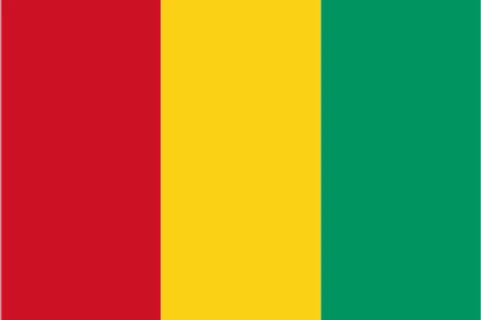
You’ll find Cameroon on these lists
Each one opens the list.
More flags taken apart in Africa
Each card opens that flag, taken apart step by step.
- Central African RepublicThe Central African Republic: a flag in one sentence
- ChadChad: three colours, no numbers
- ComorosComoros: a flag you can draw from its constitution
- Côte d'IvoireCôte d’Ivoire: three more words for the bands
- Democratic Republic of the CongoThe Democratic Republic of the Congo: a sentence from 1964
- DjiboutiDjibouti: a flag in a list of colours