The flag of Marshall Islands
Micronesia · Majuro
- navy74%
- white14%
- orange10%
Gold, blue and white. 2 other flags use just these colours.
One plate per main colour.
Tap the flag to put it back together.
Investigation
The Marshall Islands: a star with 24 points
The Marshall Islands’ flag law gives every size as a share of the flag’s height, right down to the circles inside its star. Build it up a step at a time, and see the places where today’s flag and the law’s words don’t agree.


The Marshall Islands’ flag law says the flag is . Its table of sizes starts from the height, which it calls 1, and makes the length . The embassy in Washington says the deep blue stands for the Pacific Ocean.
The embassy’s page calls the flag 2 to 1, but the law’s table says 1.9.
Then come two bars, touching all the way along. The law says they run from the bottom left of the flag up to the top right. The top one is and the bottom one is .
The law leaves the exact shades to an order of the Cabinet. The colours here are the artwork’s own.
The law gives each bar’s width at both edges. By the pole, each one is of the height, just a sliver. At the far edge this artwork makes each one , more than twelve times as wide.
The law’s table actually gives each bar 0.392 at the far edge, twice what this artwork has. Drawn that way, the two bars would cover nearly four fifths of that edge. Here the two of them make 0.392 together.
The law doesn’t say what any of it means, but the embassy does. The orange bar is the chain of islands, the sunset, and the white one is the chain, the sunrise. It adds that by custom, orange is the colour of bravery and white the colour of peace.
Britannica reads the colours a little differently. It says the white is for brightness, and the orange for bravery and wealth.
In the top left corner there’s a white . The law calls it the union, and it puts the star distance from the edge by the pole, the top edge and the top of the orange bar.
The law doesn’t say where on the star to measure from. Measured from its middle, the artwork puts it right there.
The law gives the star , 15 degrees apart, so they go all the way round. The embassy says each point stands for a municipal district. The constitution lists 24 electoral districts for the Nitijela, the parliament, too.
Four of the points are longer than the rest, and they make a cross. The embassy says the star stands for the cross of Christianity, and the for the main centres, Majuro, Ebeye, Jaluit and Wotje.
The law as it’s printed today names only two longer points, the ones parallel to the fly, and twenty others, which only adds up to 22. In its table the fly is the flag’s length, so those two would point left and right. The artwork draws four, and the embassy and Britannica both say four.
The law’s table sizes the star with three circles. From point to point, the long points span of the height and the short ones . The notches between the points sit on a circle across. The artwork follows all three.
The table only calls the last one the inner circle of the union. Here it’s read as the circle the notches sit on, because that’s where the artwork puts them.
The constitution came into effect on 1 May 1979. Britannica says the flag was hoisted that day, after a design competition, and that the winning entry was by Emlain Kabua, the wife of the new government’s president, Amata Kabua. The flag law itself came into force on 12 June 1979, six weeks later.
Britannica sees more in the bars. It says the two of them together suggest the equator, which runs just south of the islands, and that they get wider to show the country’s growth and vitality. Neither the law nor the embassy says so.
The flag doesn’t show where the equator is, though. Its bars run on a slant, so it’s a hint, not a map.
You’ll find Marshall Islands on these lists
Each one opens the list.
More flags taken apart in Oceania
Each card opens that flag, taken apart step by step.
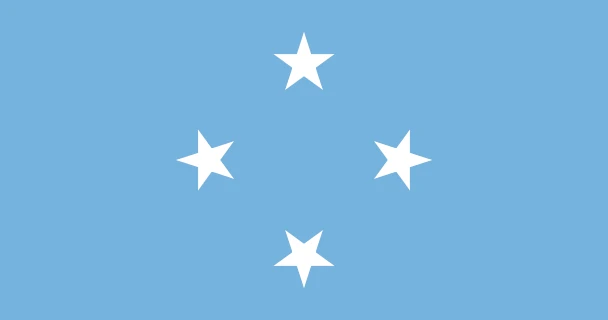
- MicronesiaMicronesia: four stars in a circle
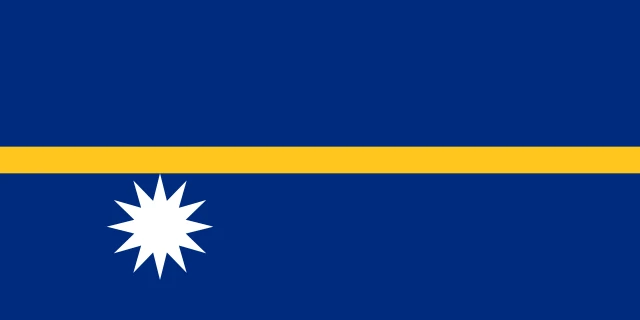
- NaoeroNaoero: a star below the equator
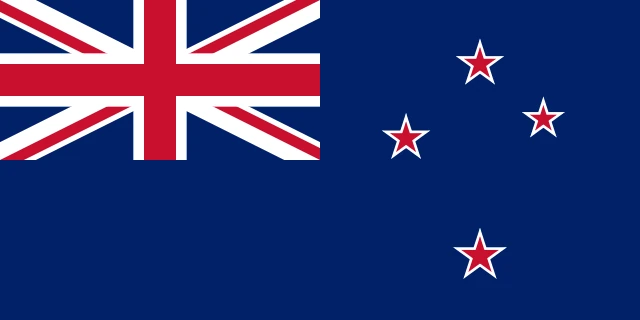
- New ZealandNew Zealand: four stars on royal blue
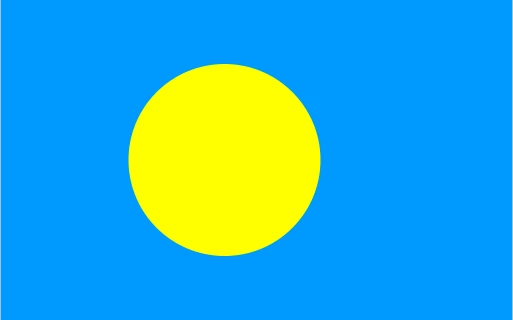
- PalauPalau: a full moon just off the middle
- Papua New GuineaPapua New Guinea: a bird of paradise on a circle
- SamoaSamoa: five stars on a blue quarter